Find out if your music will be turned down by YouTube, Spotify, TIDAL, Apple Music and more. Discover your music's Loudness Penalty score, for free.

Drag and drop an audio file here

Choose an audio file

MP3 or WAV

select a file

Your file will not be uploaded, stored or shared, meaning this process is secure and anonymous.

Online streaming services are turning down loud songs.

We all hate sudden changes in loudness - they're the #1 source of user complaints.

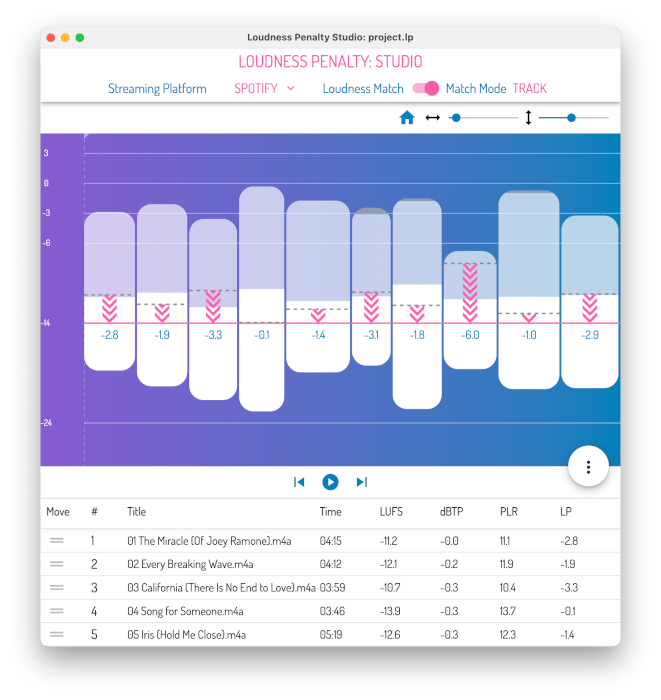
To avoid this and save us from being "blasted" unexpectedly, online streaming services measure loudness, and turn down music recorded at higher levels. We call this reduction the "Loudness Penalty" - the higher the level your music is mastered at, the bigger the penalty could be. But all the streaming services achieve this in different ways, and give different values, which makes it really hard to know how big the Loudness Penalty will be for your music...

Until now.

Simply select any WAV, MP3 or AAC file above, and within seconds we'll provide you with an accurate measurement of the Loudness Penalty for your music on many of the most popular music streaming services, and allow you to preview how it will sound for easy comparison with your favorite reference material.

Your file will not be uploaded, meaning this process is secure and anonymous.

Do you have any questions? Get in touch.
Processing audio

(but NOT uploading)

RESULTS (in dB)

0 YouTube
0 Spotify
0 TIDAL
0 Apple
0 Apple (Legacy)
0 Amazon
0 Pandora
0 Deezer

Want to take control of the Loudness Penalty for your music?

Find out how to optimize your music for impactful, punchy playback (and maximum encode quality) for all the online streaming services. Plus, receive a Loudness Penalty Report for your file that explains in detail what all the numbers mean.

Analyze another file

We just sent you an email with your report!

Analyze another file Visit MeterPlugs.com

September 1984 Penthouse Pdf Added By Request New -

Note to the reader: Always respect copyright laws. If an official reprint or digital collection of 1984 Penthouse becomes available from the rights holder, supporting that release is the best way to ensure more vintage content is preserved professionally.

For the archivist, this is a victory. For the nostalgic boomer or Gen X'er, it is a time machine to a September evening 40 years ago. For the legal department of a defunct publishing house, it is a headache. But for the internet, it is simply Tuesday: another day of keeping history alive, one grainy, high-resolution centerfold at a time. september 1984 penthouse pdf added by request new

In the sprawling archives of the internet, few things capture the intersection of vintage erotica, collector culture, and digital preservation quite like a specific string of search terms: "september 1984 penthouse pdf added by request new." Note to the reader: Always respect copyright laws

At first glance, this phrase appears to be a dry, technical query—a user looking for a digitized copy of a near 40-year-old magazine. But dig deeper, and you uncover a fascinating subculture: forum-based file sharing, the ethics of "request" threads, and the enduring allure of the Golden Age of adult magazines. This article explores why this specific issue of Penthouse remains a sought-after PDF, what "added by request" truly means in online communities, and how vintage media finds new life in the digital age. To understand the demand, we must first look at the artifact itself. Penthouse magazine in September 1984 was not just a collection of photographs; it was a cultural document. The early 1980s represented the peak of the "Penthouse Pet" era, known for its glossy, high-contrast photography and a distinct shift from the more rustic, natural look of the 1970s Playboy . For the nostalgic boomer or Gen X'er, it

Scroll down to learn more about "Loudness Penalty"
Scroll down to learn what these numbers mean