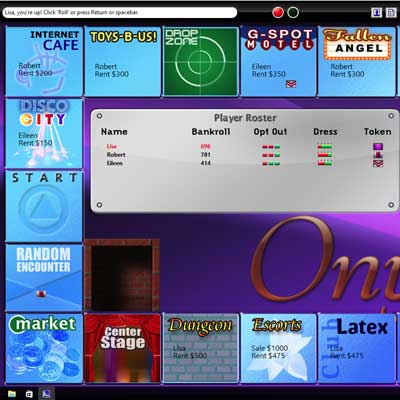
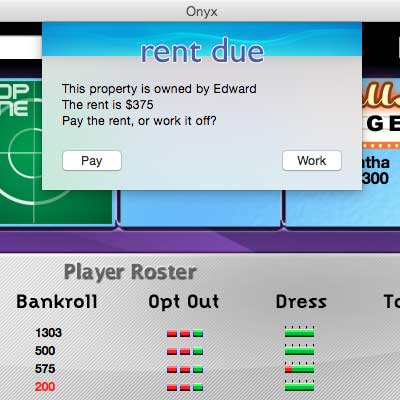
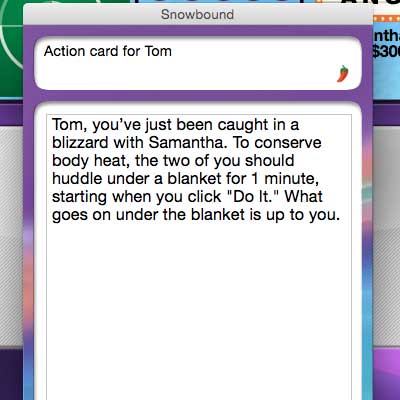
Onyx is a computer sex game. Move around the board buying up properties. If you land on a property that is owned by somebody else, you must either pay rent or work off the debt! Players work off debt with all kinds of intimate actions, from mild to kinky. As the game progresses, so does the action! Play with people you are intimate with, or want to be!
You can work off the debt by being assigned fun, sexy erotic actions.
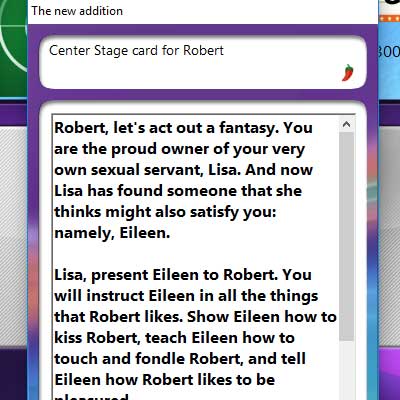
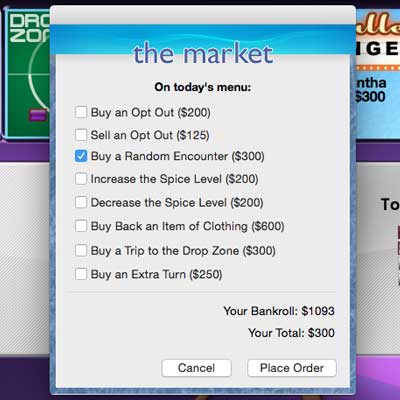
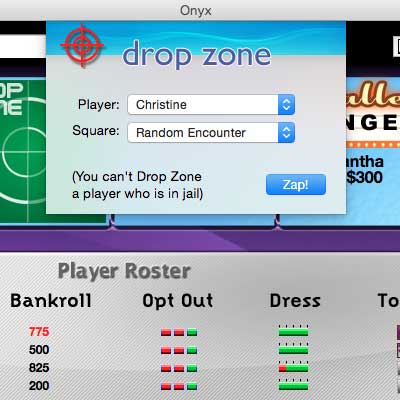
Look out for special squares! If you land on the Torture Chamber, you must draw a "torture card" with an erotic torture on it. At Center Stage, you are put on display; in the Random Encounter square, you will be assigned an erotic action with another player; and on the Fate squares, the luck of the draw dictates your fate.
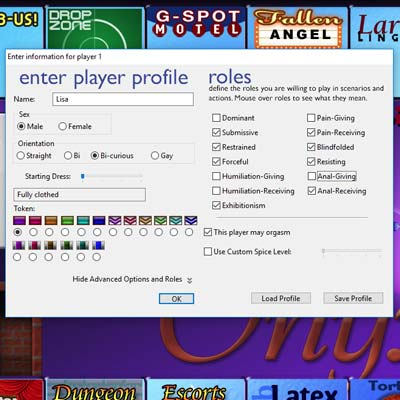
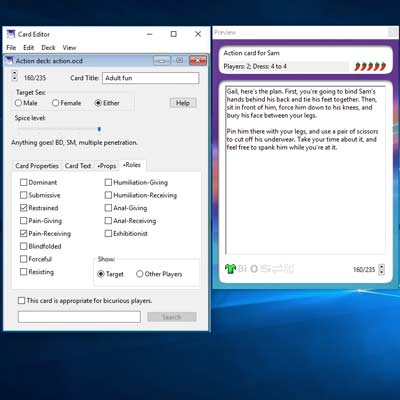
You control the "spice" of the erotic actions, from harmless fun to wild, anything-goes kink. You choose "roles," which tell the game what kinds of actions you prefer to be involved in. If you don't like being tied up, just tell Onyx that you will not accept the "bondage" role.
Onyx 3.6 and earlier did not work on Macs requiring 64-bit native apps. Onyx 3.7 now works on modern Macs, and is optimized to run natively on Apple Silicon Macs. A version of Onyx that runs natively on Windows ARM devices is also available!
UPDATE: Some Mac users were reporting an error saying “Onyx 3.7.app can’t be opened because Apple cannot check it for malicious software.” I have updated the app to address this issue; it should work properly now.
Onyx runs on Macs (OS X 10.14 or later), Windows (Windows 7 or later), Windows for ARM (Windows 11 or later), and x86 Linux (GTK 2.0+).
Onyx is available for free download. The free version can only be played on the mildest two "spice level" settings. Onyx can be registered by paying the $35 shareware fee. Registration gives you a serial number to unlock the full version, and it also gives you the Card Editor program, which you can use to create your own card decks.
Onyx contains explicit descriptions of sexual acts. Some of the high-level actions in Onyx describe erotic actions like bondage and power exchange.
IF YOU ARE OFFENDED BY SEXUAL ACTIONS, BEHAVIOR, OR DESCRIPTIONS, DON'T DOWNLOAD THIS SOFTWARE!
If you are under the legal age of consent or live in a place where this material may be restricted or illegal, YOU SPECIFICALLY DO NOT HAVE A LICENSE TO OWN OR USE THIS COMPUTER PROGRAM. There is absolutely no warranty of any kind, expressed or implied. Use it at your own risk; the author disclaims all responsibility for any kind of damage to your computer, your car, your refrigerator, or to anything else.
By downloading Onyx, you certify that you are an adult, age 18 or over, and that you consent to see materials of a sexual nature.
As we ponder the meaning behind "lqmydhxh250101hxhoppadoyoutrustmemu", we're confronted with a profound question: do you trust me? The phrase seems to imply a sense of vulnerability, as if the creator is inviting us to participate in a game of cryptographic cat-and-mouse.
To appreciate the complexity of "lqmydhxh250101hxhoppadoyoutrustmemu", let's take a brief detour into the world of cryptography. The practice of coding and decoding messages dates back to ancient civilizations, with evidence of cryptographic techniques used by the Egyptians, Greeks, and Romans.
Throughout history, coding has played a pivotal role in shaping the course of human events. From military communications to diplomatic correspondence, coded messages have enabled individuals and organizations to convey sensitive information while maintaining secrecy.
The mystery of "lqmydhxh250101hxhoppadoyoutrustmemu" remains unsolved, a testament to the enduring power of cryptography and the human imagination. While we may never uncover a definitive answer, the journey itself has provided a fascinating glimpse into the world of coding and the psychology of trust.
In a world where digital communication dominates our daily lives, codes and ciphers have become an integral part of our online interactions. From cryptic messages to encoded passwords, we've grown accustomed to deciphering complex sequences of characters to uncover hidden meanings. But what happens when we encounter a code that defies all logic and reason?
As we conclude this article, we're left with a lingering question: do you trust me? The answer, much like the enigmatic phrase "lqmydhxh250101hxhoppadoyoutrustmemu", remains a mystery waiting to be unraveled.
As we ponder the meaning behind "lqmydhxh250101hxhoppadoyoutrustmemu", we're confronted with a profound question: do you trust me? The phrase seems to imply a sense of vulnerability, as if the creator is inviting us to participate in a game of cryptographic cat-and-mouse.
To appreciate the complexity of "lqmydhxh250101hxhoppadoyoutrustmemu", let's take a brief detour into the world of cryptography. The practice of coding and decoding messages dates back to ancient civilizations, with evidence of cryptographic techniques used by the Egyptians, Greeks, and Romans. lqmydhxh250101hxhoppadoyoutrustmemu
Throughout history, coding has played a pivotal role in shaping the course of human events. From military communications to diplomatic correspondence, coded messages have enabled individuals and organizations to convey sensitive information while maintaining secrecy. The practice of coding and decoding messages dates
The mystery of "lqmydhxh250101hxhoppadoyoutrustmemu" remains unsolved, a testament to the enduring power of cryptography and the human imagination. While we may never uncover a definitive answer, the journey itself has provided a fascinating glimpse into the world of coding and the psychology of trust. From cryptic messages to encoded passwords
In a world where digital communication dominates our daily lives, codes and ciphers have become an integral part of our online interactions. From cryptic messages to encoded passwords, we've grown accustomed to deciphering complex sequences of characters to uncover hidden meanings. But what happens when we encounter a code that defies all logic and reason?
As we conclude this article, we're left with a lingering question: do you trust me? The answer, much like the enigmatic phrase "lqmydhxh250101hxhoppadoyoutrustmemu", remains a mystery waiting to be unraveled.